Independent Animation Doesn’t Need Hollywood’s Permission Anymore
Independent animation is having a moment: a new generation of filmmakers is finding audiences, financing projects, and telling original stories without waiting for the traditional studio system to say yes.
Independent Animation Doesn’t Need Hollywood’s Permission Anymore
A new generation of creators is using crowdfunding, social media, YouTube, and sheer persistence to build animation outside the traditional studio pipeline.
For generations, animation had gatekeepers. If an artist dreamed of creating an animated television series or feature film, someone with an office, a development department, and a budget eventually had to say yes. Disney had to say yes. Warner Bros. had to say yes. A television network or a distributor had to say yes.
That system produced some extraordinary films and television shows, and it still does. But something else is happening alongside it. Across YouTube, Kickstarter and social media, animators are discovering that they may no longer have to wait for Hollywood’s permission at all. Instead, they can take their ideas directly to an audience, and increasingly, that audience is the one saying yes.
Independent animators can now reach audiences without waiting for a traditional studio green light.
Crowdfunding, social media, distributed production, and direct-to-audience platforms are changing how projects get financed and discovered.
The real shift is not simply distribution. It is who gets to decide which stories are worth making.
The Audience Has Entered the Development Meeting
This change is bigger than simply putting cartoons on YouTube. For decades, studios controlled several things creators desperately needed: financing, production infrastructure, marketing, and distribution. Over the past several years, the internet has slowly chipped away at each one.
Crowdfunding now allows audiences to finance projects before they even exist. Social media lets filmmakers build communities around characters and ideas long before a project is finished. Digital production tools make it possible for artists living thousands of miles apart to work together as if they shared a studio. And YouTube provides worldwide distribution at the push of a button.
As a result, the distance between an artist and an audience has become remarkably short. That shift changes more than distribution, though. It changes who gets to decide which stories are worth telling in the first place.
Glitch Proved the Audience Could Become the Infrastructure
View this post on Instagram
The numbers are extraordinary. By July 2026, Australia’s National Film and Sound Archive reported that Glitch had reached approximately 21 million YouTube subscribers and 3.7 billion views. Yet those numbers aren’t actually the most interesting part of the story — the relationship with the audience is.
Glitch never used YouTube merely as a place to post a finished television show. Instead, the platform became part of the business model itself. Viewers discovered the shows there, shared them, created fan art, debated theories, bought merchandise, and helped transform original characters into recognizable entertainment properties. In other words, the audience didn’t simply arrive after the machine had already done its work. The audience became part of the machine. And today, Glitch is no longer the only example.
Studio Heartbreak Didn’t Wait for Permission
Consider the unlikely origin of Studio Heartbreak. According to the studio, its founders were students who had been rejected from every art internship they applied for. So, rather than waiting for someone else to open a door, they created their own opportunity. They gathered friends, peers, and artists they knew online and began developing The Lovers, an original animated short set in a dark fantasy version of Manila.
They initially created a 30-second trailer through volunteer work, then took the project directly to Kickstarter. The response changed everything: more than 7,000 people backed the project, ultimately contributing more than $400,000. Rather than adapting a familiar franchise or attaching celebrity filmmakers to attract financing, the young studio raised the money around a wholly original story. The filmmakers later used some of that funding to retroactively pay the artists who had volunteered on the original trailer.
From there, the film started traveling. The Lovers premiered at the Annecy International Animation Film Festival, played Fantasia and HollyShorts, and won Fantasia’s 2026 Gold Audience Award for Best Animated Short. On August 29, the filmmakers will make the 15-minute film available free on YouTube. Once again, the distribution chain looks nothing like the traditional Hollywood model, and perhaps more importantly, the story itself looks different too.
Why Independent Animation May Be the Real Revolution
Hollywood certainly hasn’t stopped producing original animation, and not every decision made by a large studio deserves automatic suspicion. Large animation studios employ extraordinary artists, and they have created some of the greatest animated films ever made.
Still, large budgets create large expectations. When a company invests hundreds of millions of dollars in a movie, it understandably wants to reduce risk, and established intellectual property can make that investment easier to justify.
Independent creators operate under a different equation. Their audiences may actually come looking for something specific. That could be independent animation’s greatest competitive advantage: a filmmaker doesn’t necessarily need everyone to love an idea. They just need enough people to love it passionately.
You don’t need everyone to love an idea. You need enough people to love it passionately.
Sometimes Smaller Means More Personal
Another version of this revolution is happening at the opposite end of the scale. Veteran animator Michel Gagné spent years working on productions including An American Tail, The Iron Giant and Star Wars: The Clone Wars. Yet for the past 14 years, he has also been working largely by himself on a hand-drawn animated feature called The Saga of Rex.
Rather than waiting for a studio to finance the film, Gagné supported the work through freelance projects and simply kept making it, year after year. The project began in 2012, and a Kickstarter campaign helped finance an early proof of concept. Although the property was briefly optioned, Gagné ultimately continued independently. Fourteen years later, the first trailer has finally arrived, with plans to take the completed film to festivals in 2027.
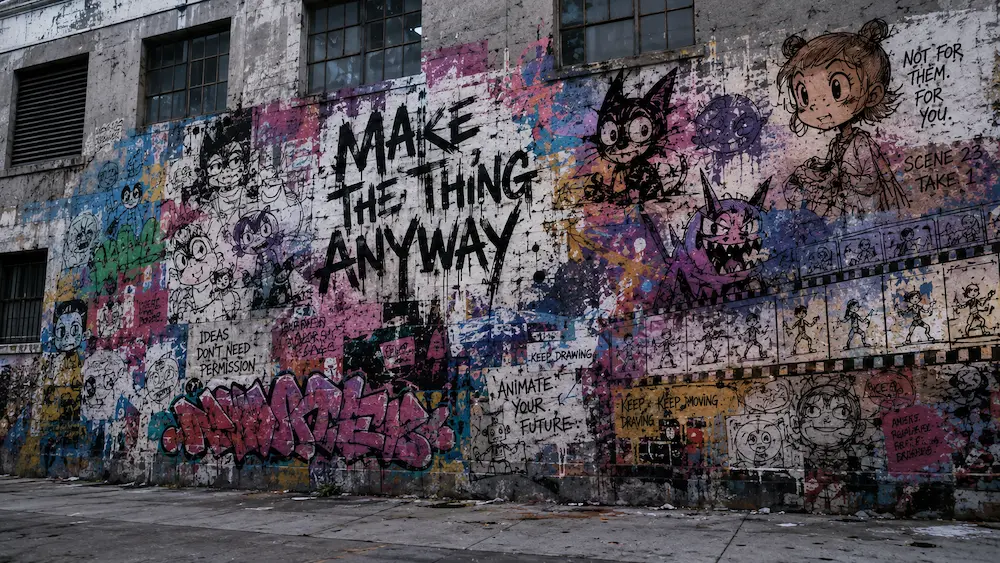
Studio Heartbreak and Michel Gagné could hardly represent more different versions of independent animation. One emerged from young artists connecting online; the other comes from an industry veteran with decades of professional experience. Yet both stories revolve around the same deceptively simple idea: make the thing anyway.
The Old Pipeline Is Becoming a Conversation
Traditionally, entertainment moved largely in one direction: creator to studio to distributor to audience. Today, another model is emerging alongside it, one built on a direct, two-way relationship between creator and audience — and that second arrow changes everything.
Audiences can now discover a project while artists are still making it. They can fund it, share it, and become emotionally invested in its success long before it’s finished. In some cases, creators can then use merchandise, crowdfunding, memberships, licensing, and direct distribution to finance whatever comes next.
That doesn’t mean this new model for independent animation is easy, though. In fact, it introduces an entirely different set of problems. Artists must become marketers. Filmmakers must build communities. Studios must manage merchandise and fulfillment. And creators must constantly feed social platforms that can change their algorithms without warning.
Most independent projects will never become The Amazing Digital Circus. Many crowdfunding campaigns will fail, and millions of views do not automatically create a sustainable company. Still, something fundamental has changed: the door is open.
What I Heard on the Floor at D23
I got a firsthand look at that tension last week at D23, Disney’s biannual fan convention, where I spent time talking with several animators who have already leaped into independent animation. Several of them told me the same thing: finding an audience is hard.
I understood the frustration, but I pushed back on it a little. Finding an audience is hard inside a studio system too. Plenty of well-funded shows quietly disappear without ever finding the audience they were built for. The difference is that, done right, an independent creator can not only find an audience of their own, but sometimes build one larger than any single studio has managed for a comparable show. It comes down to how deliberately you leverage social media and the tools already available.
None of that makes it simple, though. It’s still very much a learning game, because the internet keeps morphing and the algorithms that decide who sees what keep changing under everyone’s feet. Trying to reach an audience online can feel like shooting an arrow at a moving target. But great content is still great content, and over time, that’s what actually builds a brand and builds an audience, target or no target.
Independent animation is not replacing Hollywood. It is creating a second ecosystem alongside it — one where creators can test ideas, build audiences, and prove demand before a traditional distributor ever enters the picture.
Hollywood Isn’t Going Anywhere
It would be easy to frame all of this as independents versus Hollywood, but that framing misses the larger story. Disney isn’t disappearing. Neither are Warner Bros., Universal, Sony, Netflix or the other companies financing animation on a scale independent filmmakers cannot easily reproduce. Instead, an independent animation ecosystem is growing alongside them, and the relationship between those two worlds could eventually become far more interesting than any competition between them.
Independent creators can experiment with ideas traditional studios might consider too risky. Audiences can demonstrate demand before enormous amounts of money are spent. And successful independent properties can eventually partner with larger distributors while retaining more leverage and, potentially, more creative control. The result may not be the destruction of the studio system — it may be an expansion of what an animation studio can be.
The Next Great Animation Studio May Not Look Like a Studio
That possibility may be the most exciting part of all. For most of the last century, we knew what an animation studio looked like: it was a building. Artists came to work, executives developed projects, distributors delivered them to theaters or television networks, and audiences encountered the finished product only at the very end of the process.
The next influential animation company might look nothing like that. It might begin with five artists communicating through Discord. It might start with a 30-second trailer, or a Kickstarter campaign that unexpectedly finds 7,000 people willing to take a chance on an idea. Or it might be one animator sitting at a desk, drawing the same film for fourteen years because he believes the story deserves to exist.
None of this means independent animation no longer needs Hollywood. It means animation may no longer need only Hollywood. And for storytellers — and for the audiences searching for stories they haven’t seen before — that may be the much bigger revolution.