
Some animated films look as beautiful today as they did on opening night, decades after their release. From the tapestry-inspired world of Sleeping Beauty to the slow-burn rescue of The Iron Giant, the reasons have less to do with nostalgia than with the choices artists make at the drawing table.
Why Some Animated Films Never Seem to Age
Animation
Why Some Animated Films Never Seem to Age
From Snow White to The Iron Giant, certain animated films hold onto their beauty and emotional power decades after their premieres. The reason has less to do with nostalgia than you might expect.
By David Derks
Watching an animated film made eighty years ago produces a peculiar sensation. The world outside the frame has changed beyond recognition, and filmmaking technology has advanced well past anything the original artists could have imagined. Yet when those familiar drawings start to move, the characters still get their laughs, and their expressions still communicate exactly what they did on opening night. In many cases the artwork looks every bit as beautiful as it did when the first audiences saw it.
Disney’s Pinocchio (1940) and Sleeping Beauty (1959) make the point well. Their artists worked with pencils, paint and camera stands that would look like museum pieces next to a modern workstation, yet the finished films carry an artistic sophistication that no software upgrade has managed to replicate. We recognize their age, of course, because their orchestrations and storytelling rhythms belong to their decades. Recognizing an old film, however, is not the same as experiencing it as outdated.
Pinocchio (1940). Disney’s second feature remains a high-water mark for hand-drawn effects animation.
Recognizing an old film is not the same as experiencing it as outdated.
So why do some animated films age differently than live-action movies? The answer lies in the qualities that make animation its own art form, beginning with the fact that an animator builds a world from nothing.
Animation Builds a World Instead of Recording One
Live-action filmmaking captures whatever stands in front of the camera. Actors perform in physical spaces while wearing the clothes and haircuts of their moment, and even a carefully researched period piece tends to betray the year it was shot. The lighting and the pace of the editing usually give the game away, which is how audiences end up with 1970s Westerns where every gunslinger seems to share a hairdresser with the Bee Gees.
Animation works from the opposite direction. Rather than record reality, the artist interprets it, deciding how a tree should look and how a character should move through a room. Animators can exaggerate a proportion or abandon realism altogether, and the result is a film whose visual rules exist independently of the world outside the theater.
That world looked unusual in 1959, and it looks just as unusual today.
On Sleeping Beauty
Sleeping Beauty shows how far that freedom can go. Eyvind Earle, the film’s color stylist, drew on medieval tapestries and Gothic illumination to build a style of angular trees and densely patterned backgrounds that makes no attempt to mimic everyday life. The film follows its own artistic logic instead. That world looked unusual in 1959, and it looks just as unusual today, which may explain why it still works.
Sleeping Beauty (1959). Eyvind Earle’s tapestry-inspired designs gave the film a look no other Disney feature has matched.
The Lasting Language of Line and Shape
That independence from reality connects to animation’s greatest strength, which is its ability to say a great deal with very little. A character doesn’t need accurate anatomy to express sadness, because a lowered head or the curve of a mouth communicates the emotion instantly. A strong silhouette, meanwhile, can establish a personality before the character speaks a single word.
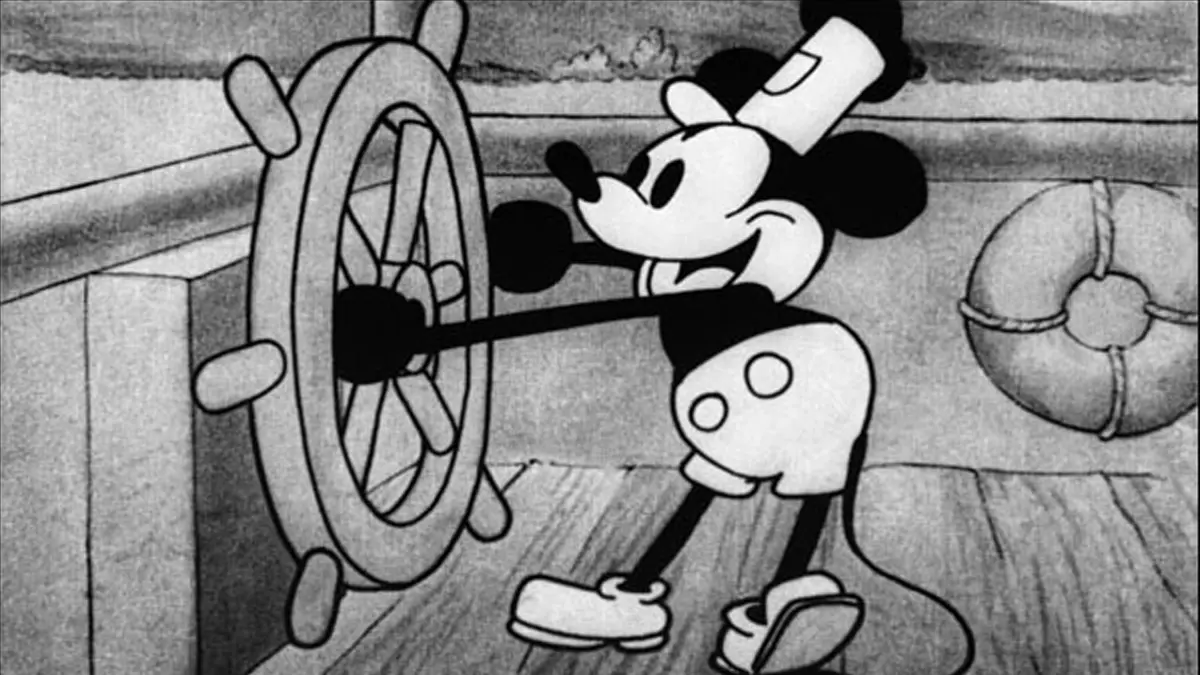
Mickey Mouse offers the textbook case. His design rests on circles and an instantly readable silhouette, and that foundation has allowed generations of artists to reinterpret him without losing what makes him Mickey. I explored how that visual identity grew into something much larger in When a Character Becomes a Brand, but the recognition always starts with an artistic choice. A successful character design communicates at a glance.
Related on DerksWorld →When a Character Becomes a Brand: How Mickey Mouse Defined Disney’s Identity
The loose, sketchy linework of One Hundred and One Dalmatians (1961) proves the principle holds across very different styles. Disney adopted a xerographic process for that film, transferring the animators’ pencil drawings directly onto cels, and the result looks nothing like the polished inking of the studio’s earlier features. Its energetic drawings still feel alive more than six decades later. Neither approach depends on photographic realism. Both rely on decisions about form and movement, and those decisions keep working long after the artistic fashions around them have changed.
One Hundred and One Dalmatians (1961). The Xerox process let the animators’ own pencil lines reach the screen.
We Meet These Characters as Children
Design explains part of animation’s longevity, but our emotional relationship with these films adds another layer. For most of us, animation arrives in childhood, at an age when our imaginations accept talking animals and impossible landscapes without demanding an explanation. We don’t question the logic of those worlds. We walk right into them, and over time the experience settles so deeply into memory that a single musical phrase can carry us back decades.
The characters haven’t aged a day. The same cannot be said for the rest of us.
Years later, we return to the same films with an adult’s understanding. We catch the sophisticated joke that sailed over our heads at age seven, or we notice the craftsmanship behind a sequence we once watched only for the chase. The characters, meanwhile, remain exactly as we remember them. They haven’t aged a day, and that constancy forges a powerful bond between the audience and the artwork. Nostalgia alone, however, cannot explain why these films endure.
A New Generation Finds an Old Film
If childhood memory were the whole story, these films would lose their audiences as each generation passed. Instead, new viewers keep discovering them. A child watching Snow White and the Seven Dwarfs (1937) today doesn’t need to understand the Great Depression or the Hollywood studio system to follow the story. The child only needs to understand the characters and what they feel.
Snow White and the Seven Dwarfs (1937). Nearly nine decades on, the Queen’s transformation still frightens first-time viewers.
The same principle explains why younger audiences keep seeking out movies made long before they were born, a trend I examined in Why Young Audiences Are Discovering Movies Made Before They Were Born. Great storytelling crosses generations because its emotional foundations stay recognizable. Jealousy doesn’t belong to any particular decade, and neither does the courage it takes to stand up to it.
Related on DerksWorld →Why Young Audiences Are Discovering Movies Made Before They Were Born
Animation communicates those experiences through an especially direct visual language. A frightened character can shrink into a small shape, while an angry one can harden into a collection of sharp angles. These exaggerations don’t weaken the emotion. More often they strengthen it, because the artist can put an idea on screen that live action would struggle to express without a visual effects budget the size of a small nation’s economy.
Sometimes Simplicity Outlasts Technology
Technological progress, interestingly, doesn’t guarantee that an animated film will age well, and early computer animation offers a telling example. When Pixar released Toy Story in 1995, audiences witnessed the first feature built entirely from computer-generated imagery, an achievement that would reshape the industry within a decade.
Toy Story (1995). The rendering shows its age, but Woody and Buzz have not lost a step.
Today, viewers can spot the limits of that early technology. The human characters move with a noticeable stiffness, and some surfaces look as though they came straight off a plastics assembly line, which admittedly suits a movie about toys better than it suits Andy’s mom. Yet Toy Story remains enormously entertaining, because its characters and its emotional storytelling carry the film even as the rendering reveals its age.
Compare that experience with Pinocchio, made fifty-five years earlier. Its drawings can’t become technologically obsolete in the same way, because audiences judge them as illustrations, and their appeal comes from draftsmanship and timing rather than from any pursuit of photographic realism. None of this means hand-drawn animation always ages better than computer animation. Contemporary digital artists produce extraordinary work, and many computer-animated films adopt styles that sidestep realism entirely. The distinction reveals something more basic about the medium.
Technology goes out of date. A strong artistic choice stays compelling.
Some Films Find Their Audience Years Later
Not every animated film succeeds right away, and some build their reputations only after audiences have had time to find them. The Iron Giant (1999) offers a striking example. Brad Bird’s film arrived when moviegoers associated feature animation with Disney musicals and the new wave of computer-generated spectacle. Instead of competing with either, it told a restrained story about a boy and a mysterious robot in a small Maine town gripped by Cold War fear.
Bird blended traditional character animation with computer-generated elements while keeping a cohesive, illustrated look, and he placed the film’s emotional weight on the friendship at its center rather than on visual fireworks. Warner Bros. struggled to market the picture, and its theatrical run disappointed. Over the following years, however, the film built a devoted following on home video, and its themes of identity and personal choice feel as relevant now as they did in 1999.
The Iron Giant (1999). A box office disappointment that became one of the most beloved animated films of its generation.
A film doesn’t need to win opening weekend. It needs viewers who keep passing it along.
On The Iron Giant
That slow-burn longevity also explains the enduring appeal of the films I covered in 10 Cult Animated Films That Changed Animation. An animated film doesn’t need to capture the largest possible audience on opening weekend. It needs to connect deeply enough that viewers keep passing it along, and over time those connections become part of its legacy.
Related on DerksWorld →10 Cult Animated Films That Changed Animation
Animation Can Age Poorly, Too
Not every animated film survives the decades gracefully. Some contain cultural stereotypes or dated humor that make contemporary audiences wince, while others lean so heavily on fashionable effects and pop culture references that they lose their meaning once the culture moves on. Animation reflects the society that creates it, just as live action does, and plenty of live-action films remain remarkably timeless in their own right.
The real question, then, isn’t whether animation automatically ages better than live action. It doesn’t. The more interesting question is why certain animated films keep their artistic and emotional appeal across the decades, and the answer usually comes down to the clarity of their visual language and the strength of their storytelling. A beautifully drawn character doesn’t stop being beautifully drawn because the calendar changes, and a perfectly timed expression doesn’t lose its meaning because we now watch movies on our phones.
A beautifully drawn character doesn’t stop being beautifully drawn because the calendar changes.
The Art Stays Where We Left It
Perhaps animation’s most remarkable quality is the relationship it creates between the artist and the audience. An animator draws a character that never existed in the physical world, and through movement and timing that character develops a personality. Audiences respond emotionally to something built entirely from imagination, and decades later that connection can remain intact.
The artists may be gone, and the studios may have changed hands more than once. The equipment that produced the film may now sit in a museum archive. Yet the character still moves, and the audience still responds. As we grow older, we bring new experiences to the films we loved as children, noticing details and meanings that escaped us the first time around. The artwork, however, remains exactly where we left it.
That may be the real reason some animated films never seem to age. They don’t preserve the world as it once looked. They preserve the way someone once imagined it, and a beautiful idea, drawn by hand and set in motion, has a way of outlasting everything around it.
DerksWorld