Classic Cartoon Writing: Why These Cartoons Weren’t for Kids
There are voices you recognize instantly.
And then there are voices you’ve known your entire life—without ever realizing how much intention, intelligence, and writing lived behind them.
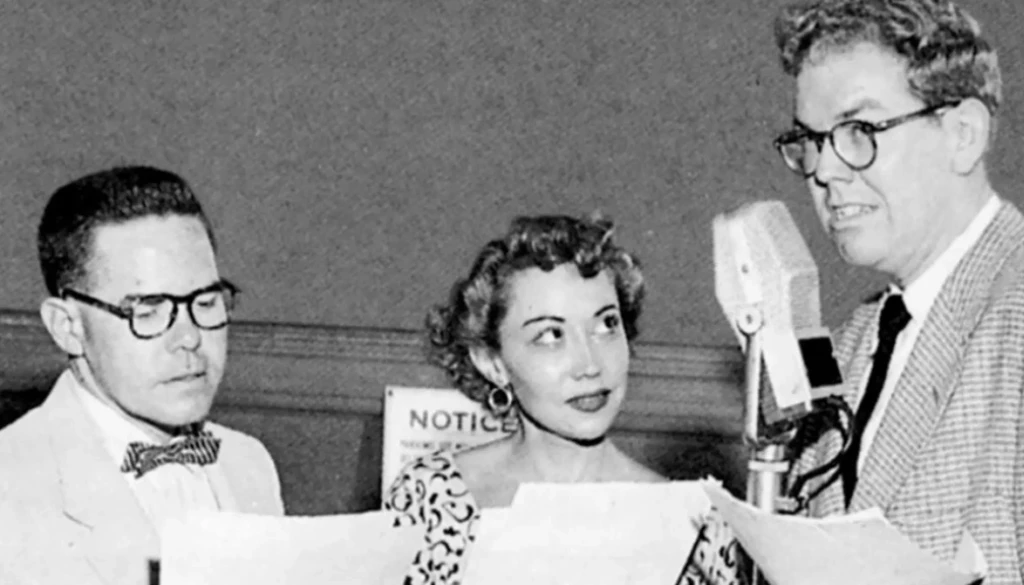
June Foray was a legendary voice actor. But the conversations I remember most with her weren’t really about performance. They were about writing—and about what animated cartoons were actually trying to be during that era.
Looking back now, that distinction matters.
Who June Foray Was—and Why She Was There
June Foray was one of the most prolific American voice actors in animation history. Her career spanned radio, television, and film, and she worked across studios such as Warner Bros., MGM, Hanna-Barbera, Jay Ward Productions, and Disney.
She voiced an extraordinary range of characters, from Rocky the Flying Squirrel and Natasha Fatale to Granny, Witch Hazel, and Lucifer the Cat. But while her performances were iconic, June understood something deeper about animation: voices serve the writing.
And the writing, she believed, was never meant to be simplistic.
A Conversation About What Cartoons Really Were
I was fortunate to know June Foray, and one conversation in particular has stayed with me.
We were talking about The Adventures of Rocky and Bullwinkle, and I mentioned that as an adult, I had gone back and watched segments like Fractured Fairy Tales. What struck me was realizing how many of the jokes clearly weren’t written for children at all.
June laughed.
She told me that Rocky and Bullwinkle was never meant to be children’s television. It was simply adults writing for adults—sharp, satirical humor delivered through animation. The idea that it was “for kids” came later, largely because of the medium rather than the intent. Even though the show was produced for Saturday morning children’s programming, it wasn’t
That moment reframed how I saw the entire era.
Super Chicken and the Writing You Don’t Catch as a Kid
As a child, I loved Super Chicken simply because it was a cartoon. The action kept moving, the characters felt strange and memorable, and the situations were endlessly unpredictable. At the time, that was enough. However, when I revisited the series as an adult, everything changed. I began to notice how carefully the jokes were constructed. More importantly, I finally understood who this classic cartoon writing was really written for.
One episode, in particular, captures exactly what June Foray once described about animation being far smarter than people assume. In this episode, a mad scientist creates a living toupee—a sentient hairpiece that escapes and launches a destructive rampage through Pittsburgh. As a result, buildings come under threat and chaos spreads quickly. The premise itself leans fully into surreal satire. Meanwhile, Super Chicken and Fred respond with wit and clever gadgetry. Still, the episode’s real impact comes from its finer details.
At one point, Super Chicken devises a plan to stop the toupee by worrying it until it loses its hair. The episode then delivers lines such as, “Congratulations, it’s twins. Signed, Kewpie,” followed shortly by, “Special delivery from the draft board—you have been classified 1A.” As a child, those jokes passed right by me. As an adult, however, they land immediately. These are unmistakably adult jokes, written with confidence and precision. They exemplify how classic cartoon writing trusted its audience to be smarter than expected.
That confidence is the point. Kids laugh at the chaos. Adults catch the subtext. In the end, animation was never the limitation. Instead, it served as the perfect disguise.
Animation as a Delivery System, Not a Target Audience
What June Foray understood—and what many of us only realize years later—is that animation in that era wasn’t defined by who it was for, but by how it was written.
These cartoons trusted their audience. They layered humor. They embraced irony, wordplay, cultural references, and satire. Children could enjoy the surface. Adults could appreciate the subtext.
Animation wasn’t the message.
It was the delivery system.
Why This Perspective Still Holds Up
Today, we talk about “adult animation” as if it’s a modern invention. But shows like Rocky and Bullwinkle and Super Chicken were already doing it decades ago—without branding, without disclaimers, and without apologizing for their intelligence.
June Foray wasn’t just voicing characters in that world. She was helping bring sophisticated writing to life, fully aware of what it was doing and who it was really speaking to.
That’s the legacy worth revisiting.
A Medium That Trusted Its Audience
June Foray passed away in 2017, but the writing she helped deliver still works—because it was never built on trends or assumptions about age.
If you’ve ever rewatched a cartoon from your childhood and suddenly realized, “Oh… this wasn’t meant for kids,” you’ve uncovered the same truth she was pointing to.
Some cartoons don’t age.
They reveal themselves.
For more on June Foray, there’s a short biography by Charles Solomon on ASIFA-Hollywood’s website.