Why We Want to Be Scared
When we walk toward something built to frighten us, what can the people who build it learn from us?
Why We Want to Be Scared
When we walk toward something built to frighten us, what can the people who build it learn from us?
On opening night of Universal’s Halloween Horror Nights, I noticed something that had little to do with the production values or the crowds pressing toward the next maze. People wanted to be scared. More than that, many of them wanted to be scared by something they already knew.
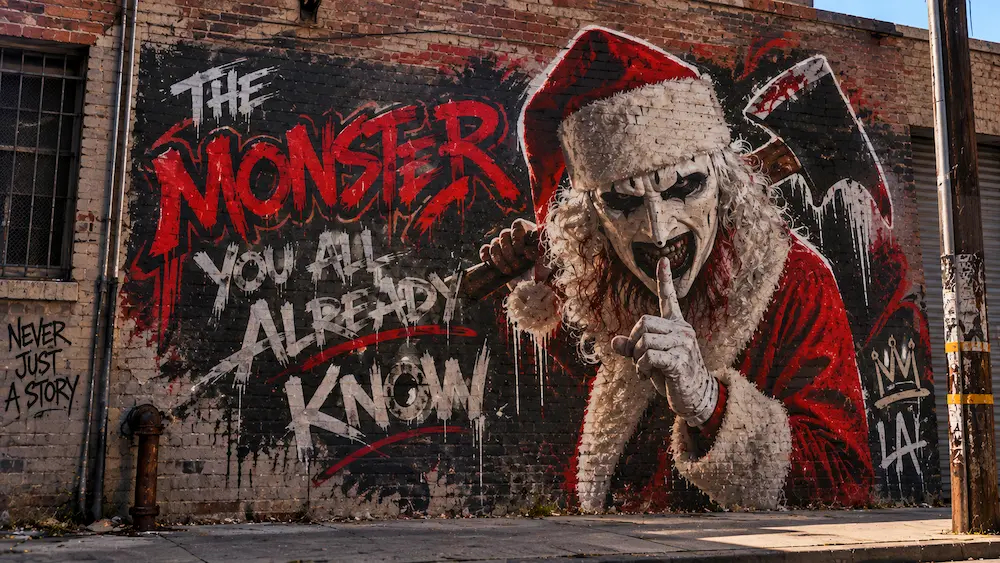
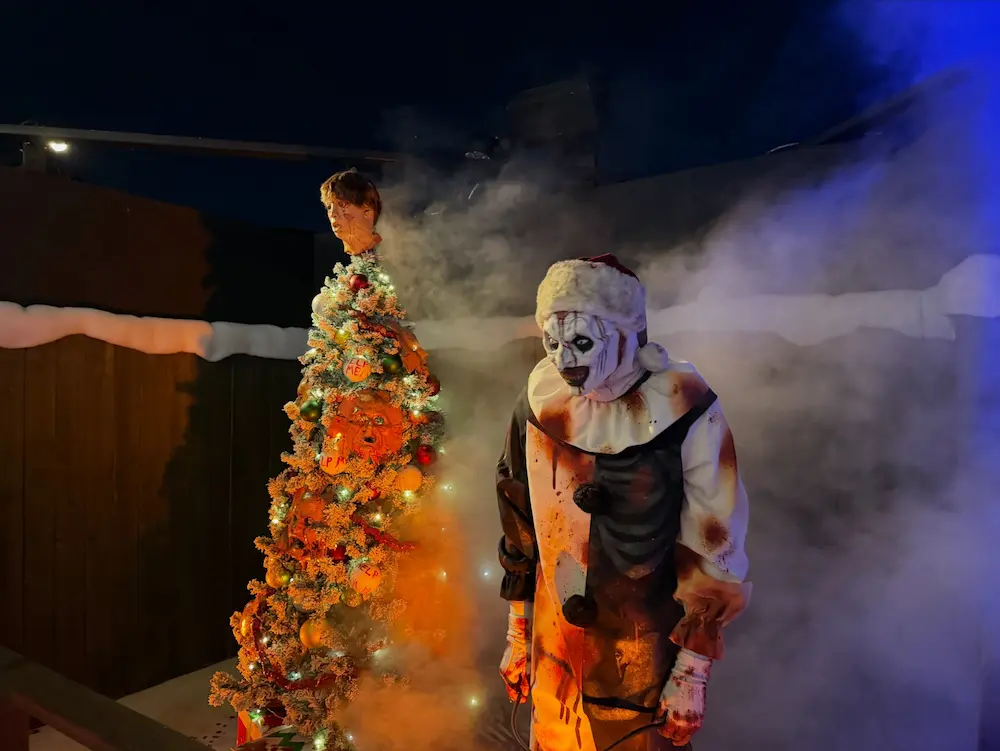
Much of Halloween Horror Nights builds its attractions around intellectual property the audience already carries with it. Guests recognize the characters and the mythology built around them before they ever cross the threshold. Art the Clown, of the Terrifier franchise, needs no introduction at this point. His fans already know who he is and, more to the point, what he is capable of doing to them once the lights go out.
That familiarity produces a small contradiction worth sitting with. We tend to think of fear as a response to the unknown, yet thousands of people will wait an hour in line for the privilege of meeting a monster they could practically describe from memory. Why would recognition, which usually defuses suspense, instead seem to sharpen it here?
The answer stretches well past October. Research into fear and audience behavior suggests that frightening entertainment gives us an unusually safe laboratory in which to rehearse danger. The rise of internet-born horror like Backrooms suggests something else worth a creator’s attention: an established franchise, or even a studio, turns out not to be a requirement for tapping into that same hunger.
Maybe the monster was never really the point. Maybe the subject worth studying is what happens inside the person watching it approach.
Fear works because audiences can know they are safe while their bodies still respond to danger.
Familiar monsters can actually intensify anticipation because audiences bring their own memories into the experience.
For creators, the success of internet-born horror suggests that atmosphere, curiosity and emotional response can matter more than budget or established intellectual property.
We Know It Isn’t Real. Our Bodies React Anyway.
When something lunges at us inside a haunted attraction, we understand exactly what is happening. We bought the ticket ourselves. We walked in through a lit entrance under a neon sign, and somewhere beneath the latex waits a performer who will clock out later that night and drive home.
And still we scream.
That reaction doesn’t mean the brain fails to tell fiction from reality. If anything, our conscious awareness that the danger isn’t real is what makes recreational fear possible in the first place. It’s the older, faster systems inside us, the ones built to register a sudden movement in the dark before we’ve had time to think about it, that keep responding on their own schedule regardless of what we know.
A team of psychologists at Caltech went looking for exactly that gap in 2022, sending more than a hundred and fifty haunted-house visitors through seventeen rooms of staged threats while skin-conductance sensors tracked their nervous systems. Their results, published in Psychological Science, showed genuine spikes in arousal, sharper for threats visitors couldn’t predict than for ones they saw coming, even though everyone in the study had walked in already knowing that nothing inside the building could actually hurt them.
Two things happen at once. The mind insists that everything is fine. The body disagrees, and for a few seconds, the body wins.
That contradiction might be horror’s most reliable tool.
There Is a Sweet Spot for Fear
People who study what researchers call recreational fear have found that enjoyment doesn’t rise in a straight line alongside fright. Instead, there’s a sweet spot, and it sits somewhere in the middle.
An experience that isn’t frightening enough starts to feel like a guided tour. One that overwhelms a visitor stops being fun almost immediately, tipping past thrill into something closer to real distress. Between those two failures lies a narrow band where fear turns into exhilaration instead.
Mathias Clasen and his colleagues at Aarhus University’s Recreational Fear Lab tested that idea directly. In a 2020 study published in Psychological Science, they strapped heart-rate monitors onto more than a hundred visitors moving through Dystopia, a Danish haunted house built specifically for scientific study, and charted an inverted U between fear and enjoyment. The visitors who reported the most pleasure weren’t the ones who stayed calmest, and they weren’t the ones who came closest to panic either. They sat in the moderate range, where arousal ran high enough to feel electric without tipping over into real distress.
That finding will sound familiar to anyone who has designed a good scare, whether on a soundstage or inside a plywood maze. You build tension, hold it a beat longer than feels comfortable, and then let it go. You give the audience room to catch its breath before coming back for another pass. A well-made horror experience isn’t an assault so much as a negotiation, one where the creator keeps adjusting the pressure based on how the audience happens to be breathing.
Some of Us Want More Fear Than Others
No two people walk through the same haunted house in quite the same way.
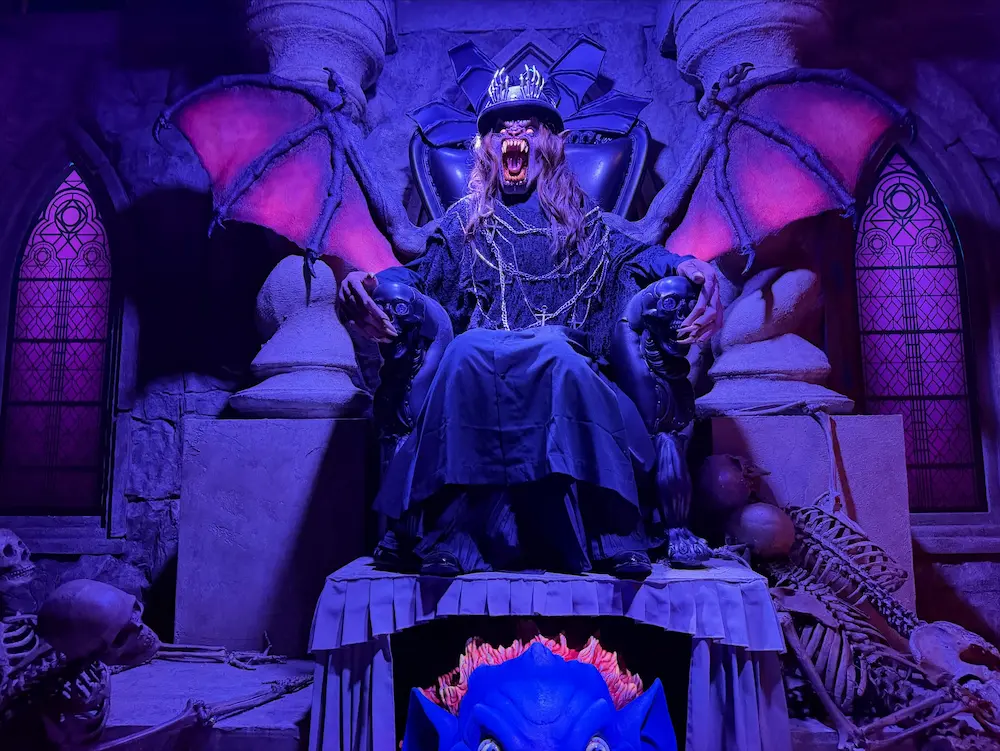
Clasen returned to the same question with two colleagues in a 2019 study in the journal Poetics, this time asking how visitors manage their own fear rather than just how much of it they feel. The data sorted people into two recurring types: those who actively work to amplify their own fear, and those who work just as hard to dampen it. The paper calls them adrenaline junkies and white-knucklers, terms anyone who has gone through a maze with friends will recognize immediately. One person strides ahead into the fog hunting for the next jump scare. The other grips a friend’s sleeve and refuses to look anywhere but straight ahead.
Both of them can walk out having had the time of their lives.
That distinction matters because horror doesn’t happen to an audience so much as with it. Visitors work to shape their own experience while it’s underway, in ways both visible and small. We look away at the last second, or cover our eyes and watch through the gaps between our fingers. Then we laugh immediately after we scream, half in relief and half in embarrassment, and insist to whoever we came with that we weren’t actually scared, even though everyone standing there knows better.
Seen this way, horror starts to look less like a product and more like a form of play, one where the fear itself is the toy.
Horror doesn’t happen to an audience.
It happens with it.
Fear Lets Us Visit Dangerous Worlds and Come Home Safely
There’s another theory worth considering, one the Aarhus scholar Mathias Clasen has laid out at length in his book Why Horror Seduces. It treats frightening entertainment as a kind of simulation, built on the same logic that makes children rehearse chase games and adults rehearse worst-case scenarios in their own heads long before anything actually goes wrong.
Horror lets us step into threatening situations without absorbing any of their real consequences. We can imagine being hunted, or trapped somewhere with no way out, all while sitting in a movie theater or standing in a fake hallway with an exit sign glowing a few yards behind us.
During the COVID-19 pandemic, the psychologist Coltan Scrivner and a group of collaborators, Clasen among them, turned up something striking. In a study published in Personality and Individual Differences, they found that people who identified as horror fans reported less psychological distress over that period than people who didn’t, and that people drawn to apocalyptic and “prepper” fiction reported feeling more prepared for what was actually happening around them.
None of this proves that watching horror movies builds resilience on its own. Personality almost certainly shapes both the taste and the trait. But the researchers raised a possibility worth taking seriously: frightening fiction may give people a low-stakes rehearsal space, somewhere to mentally walk through danger long before real uncertainty ever knocks on the door.
Horror lets us visit terrible places. Then, crucially, it lets us leave them.
We Are Also Curious About Things That Frighten Us
Fear isn’t the only thing pulling us toward the genre.
Psychologists also study something they call morbid curiosity, our drive to learn more about whatever is dangerous or disturbing. Scrivner built and validated a Morbid Curiosity Scale in a 2021 study spanning more than thirteen hundred participants, and found that the trait reliably predicts how drawn a person is to threat-related media, horror very much included. That same curiosity runs underneath a huge share of popular culture, from our appetite for disaster footage to our enduring fascination with true crime and the people behind it.
We don’t necessarily want the danger itself to reach us. We want information about it, gathered from a safe distance. Horror is remarkably good at supplying both halves of that transaction at once. It presents something threatening, then hands us a way to examine it closely without any real risk attached.
Every closed door in a horror story becomes a question the audience can’t quite let go of. What’s on the other side? Every film we’ve ever seen has told us, in one form or another, not to open it, and still some part of us keeps hoping somebody will.
Existing IP Gives Fear a Head Start
Which brings us back to Halloween Horror Nights.
Universal holds an enormous advantage whenever an attraction draws on intellectual property audiences already carry with them. Guests don’t walk in as blank slates. They walk in with memories already loaded, ready to be triggered by the right cue.
If a familiar face appears at the far end of a hallway, the attraction doesn’t need to spend any time explaining why that face should worry you. Your own memory does that work before the actor has even moved. A costume alone can set it off. So can a musical cue, or a room built to resemble one you’ve already seen on screen, or sometimes nothing more than a silhouette glimpsed for half a second before the fog swallows it again.
Recognizable IP, in other words, carries more than brand recognition into the room. It carries stored emotional information the audience supplies for free. Before anything has actually happened, the crowd has already started imagining what could.
Familiarity, it turns out, doesn’t necessarily dull fear. Handled well, familiarity manufactures anticipation, which might be the more valuable currency of the two.
Watching the Story Isn’t the Same as Entering It
That distinction may also explain why physical attractions have become such powerful extensions of these properties in the first place.
A film can show us someone walking down a frightening hallway, camera trailing a few steps behind. A haunted attraction puts us in that hallway ourselves, with nowhere to cut away. Where a film can only show a character being chased across a room, a maze can arrange for something to chase us instead, footsteps and all.
Psychologists have a name for the sense of becoming absorbed inside a fictional world: narrative transportation, a term the researchers Melanie Green and Timothy Brock coined in a landmark 2000 study in the Journal of Personality and Social Psychology. Their work, and the research it has inspired since, describes how deeply a well-told story can pull an audience in, reshaping what people believe and feel long after the story itself has ended. Theme parks take that same relationship and give it a body, turning what used to be a fictional environment into a physical one you can actually walk through.
The story stops happening to someone else on a screen. For a few minutes, it happens to you.
The story stops happening to someone else. For a few minutes, it happens to you.
Fear Becomes Even More Interesting When We Experience It Together
Anyone who has gone through a haunted maze with friends knows that the people standing next to you can end up being just as entertaining as the attraction itself.
Someone shrieks at a shadow that turns out to be nothing. A friend doubles over laughing at exactly that shriek. A hand closes around someone’s shoulder half a second before either of them quite realizes what they’ve done, and afterward, everyone spends the rest of the night arguing about who was actually scared and who was only pretending.
That Caltech study mentioned earlier turned up something relevant here too. Visitors who went through the haunted house with more friends around them showed higher overall arousal than those who went through with fewer, a kind of fear passing from person to person that the researchers called fear contagion. A newer study out of the Aarhus lab, still working its way through peer review, has pushed the question further, tracking whether people’s heart rates actually rise and fall in sync as they move through an attraction together, and finding early evidence that the effect grows stronger between people who are already close.
The attraction, in that sense, doesn’t end at the exit gate. The audience keeps narrating it long after the fact. Did you see what was right behind you? I knew that one was coming. You nearly knocked me over back there. I am never doing this again, someone always says, and then, almost without fail, does it again the following October.
Then Backrooms Flips the Equation
Established intellectual property explains a great deal of what happens at an event like Halloween Horror Nights. But another recent horror phenomenon asks us to look at the same relationship from the opposite direction entirely.
Backrooms didn’t start life as a Hollywood franchise. It grew out of internet culture, built by someone with no studio behind him and no existing audience waiting.
Kane Parsons was sixteen years old when he uploaded The Backrooms (Found Footage) to YouTube in 2022. Working with tools like Blender and Adobe After Effects, he took an existing internet concept, the unsettling image of an endless, half-lit liminal space, and built his own strange visual world out of it. The fluorescent lights hummed overhead at a pitch that never quite resolved, and the yellow walls stretched identically in every direction, promising without ever confirming that something else was nearby.
Millions of people watched. Parsons kept expanding the mythology across additional videos, and the audience kept following him deeper into it. Eventually the project made an extraordinary leap from internet-born horror to a feature film produced by A24, with Parsons directing.
On the surface, that path looks like the mirror image of Halloween Horror Nights. Universal takes established entertainment IP and turns it into a physical experience. Parsons took an unsettling idea with no built-in audience, shaped a distinctive world around it, and watched that world grow until the mainstream entertainment industry came looking for him.
Underneath those very different routes, though, sits the same question. What actually makes someone want to walk into a frightening world in the first place?
Backrooms Didn’t Need a Famous Monster
This is where the story gets particularly useful for anyone trying to make something scary of their own.
Backrooms didn’t have the built-in advantage that an established horror franchise brings to a theme park. It didn’t need one. The environment itself did the frightening. Its rooms went on for longer than felt reasonable, and its corridors repeated themselves just often enough to make a viewer doubt whether they had already passed this same corner a moment ago. Isolation did the rest, along with the persistent, nagging suspicion that something else might be sharing the space.
None of that sounds frightening on its own. An empty hallway isn’t inherently dangerous. But put a person inside it, alone, and the mind starts generating its own questions without any prompting. Why is this place so empty? Where does that hallway actually lead? Am I even supposed to be here?
That’s where one of horror’s more useful lessons for creators comes into focus. The creator only has to provide the room. The audience arrives ready to furnish the fear itself.
You Don’t Need to Wait for Hollywood to Scare Someone
The rise of internet-born horror also rewrites the relationship between the people who make things and the people who watch them.
For most of Hollywood’s history, a filmmaker generally needed financing and a theater willing to show the finished picture before finding out whether an idea would connect with anyone at all. Digital platforms have upended that order entirely. A creator today can develop an idea and put it in front of an audience directly, watching in real time to see what happens. The work finds an audience of its own, and every so often that audience pulls the whole project into a much larger world than the one it started in.
That doesn’t mean every viral video is destined to become a movie, and it shouldn’t necessarily be the goal for every creator who tries one. What matters more is that creators can now find their audience well before the traditional entertainment industry ever gets involved in the process.
Horror may be especially well suited to that new order. A frightening idea rarely requires an enormous budget to land. Sound alone can do a remarkable amount of work, and so can the simple discipline of making an audience wait a little longer than feels comfortable.
Most importantly, a filmmaker in this position never has to manufacture every ounce of fear alone. The audience brings its own imagination through the door, and imagination, it turns out, scares people more efficiently than almost anything a production budget can buy.
Perhaps Creators Should Start With a Feeling
All of this suggests a different way of approaching horror from the very beginning.
Instead of starting with a question like what kind of horror movie can I actually afford to make, a creator might start somewhere else entirely. What do I want the audience to feel once the lights go down?
Unease sits at one end of that spectrum, with isolation and dread not far behind it. Plain curiosity belongs somewhere in that mix too, along with that harder-to-name sensation of claustrophobia: the discomfort of knowing something is wrong without being able to explain exactly what.
Once a creator has settled on that feeling, every other decision in the project can serve it. The camera’s position answers to it, and so does whatever the soundtrack chooses to reveal or withhold. So does the amount of information a scene releases at any given moment, especially the amount it holds back a beat longer than feels fair. The physical environment answers to that same feeling, as does the pace at which the story lets a viewer move through it. Above everything else, so does the precise instant when the audience finally understands that something has gone wrong.
Parsons never needed generations of moviegoers to recognize a famous monster before Backrooms could make them uncomfortable. The environment alone gave viewers just enough information to start frightening themselves, which may be one of the more democratizing truths about the entire genre. Fear remains one of the only special effects an audience willingly supplies on its own.
Fear remains one of the only special effects an audience willingly supplies on its own.
Halloween Turns Fear Into a Shared Ritual
All of this helps explain why Halloween occupies such a strange and durable place in popular culture.
For a few weeks each year, an entire society gives itself official permission to play with fear in public. We decorate our front porches with skeletons and dress up as monsters to walk around our own neighborhoods after dark. We tell ghost stories out loud and watch films we already know will unsettle us. Then we wait in long lines for attractions built to frighten us on purpose, letting imagery into public spaces that would seem completely out of place during any other month of the year.
Often, we do it in groups, which changes the entire texture of the experience. Halloween takes horror out of the category of something we passively consume and turns it into something we actively perform together instead, a shared cultural ritual that resets itself every autumn.
From Screen to Audience, and Back Again
Standing inside Halloween Horror Nights, it would be easy to assume that Universal and a teenager uploading a strange short film to YouTube occupy opposite ends of the entertainment industry. In a lot of ways, they do.
One begins with recognizable intellectual property and an audience that already knows its characters by heart, backed by a studio’s resources. The other begins with a laptop and an unsettling idea, aimed at an audience that hasn’t shown up yet.
And yet both of them ultimately depend on exactly the same thing. The audience has to feel something real, or none of the rest of it matters.
At Horror Nights, that story travels from the screen into a physical space. An established property builds a fandom, and the fandom eventually fills a physical attraction that becomes a shared memory people carry home with them. Internet-born horror can travel in the opposite direction entirely, starting with a single creator and a small idea, gathering a community around it, and eventually growing into intellectual property that reaches a far larger entertainment world than the one it began in.
Every so often, those two paths cross in the middle. Audiences don’t only want to know that these worlds exist somewhere out there. Sometimes they want to walk directly into them.
Maybe That’s What We’re Really Looking for When We Ask to Be Scared
For decades, one of Hollywood’s most basic questions has stayed remarkably stable. Will an audience watch this?
But experiences like Halloween Horror Nights, alongside the emergence of creators like Kane Parsons, suggest that a second question matters just as much now. Will an audience want to enter it?
Something changes the moment a story makes that leap. We stop being spectators and start participating instead, screaming and laughing without quite meaning to, grabbing the person standing next to us before we’ve had time to think about it. We record ourselves walking through the experience, then tell everyone we know exactly what happened to us in there. Some of us go on to make our own versions, inspired by whatever just scared us.
And every so often, an audience stumbles across a strange, frightening little world somewhere online, shares it with millions of other people, and helps turn it into the next piece of intellectual property everyone eventually recognizes on sight.
That may be exactly why Halloween remains so powerful for anyone who tells stories for a living. It’s a yearly reminder that audiences were never really after the monster itself. What they want is anticipation, and the particular thrill of not quite knowing what happens next. What they want, in the end, is the relief of discovering that they survived something that was never actually going to hurt them.
More than anything, they want to feel something real, even if only for an hour.
Universal can build an entire maze to produce that feeling. A single filmmaker can produce the same thing with nothing more than an empty hallway and the patience to let it sit there a moment too long.
The tools keep changing. What the audience brings with it into the dark does not.
The tools keep changing.
What the audience brings with it into the dark does not.
Further Reading
- Tashjian, S.M., Fedrigo, V., Molapour, T., Mobbs, D., & Camerer, C.F. (2022). “Physiological Responses to a Haunted-House Threat Experience.” Psychological Science. Press release
- Andersen, M.M., Schjoedt, U., Price, H., Rosas, F.E., Scrivner, C., & Clasen, M. (2020). “Playing With Fear: A Field Study in Recreational Horror.” Psychological Science. Coverage
- Clasen, M., Andersen, M.M., & Schjødt, U. (2019). “Adrenaline Junkies and White-Knucklers: A Quantitative Study of Fear Management in Haunted House Visitors.” Poetics, 73. ScienceDirect
- Scrivner, C., Johnson, J.A., Kjeldgaard-Christiansen, J., & Clasen, M. (2021). “Pandemic Practice: Horror Fans and Morbidly Curious Individuals Are More Psychologically Resilient During the COVID-19 Pandemic.” Personality and Individual Differences, 168. ScienceDirect
- Scrivner, C. (2021). “The Psychology of Morbid Curiosity: Development and Initial Validation of the Morbid Curiosity Scale.” Personality and Individual Differences, 183. ScienceDirect
- Green, M.C., & Brock, T.C. (2000). “The Role of Transportation in the Persuasiveness of Public Narratives.” Journal of Personality and Social Psychology, 79(5). PubMed
- Clasen, M. (2017). Why Horror Seduces. Oxford University Press. Publisher listing