
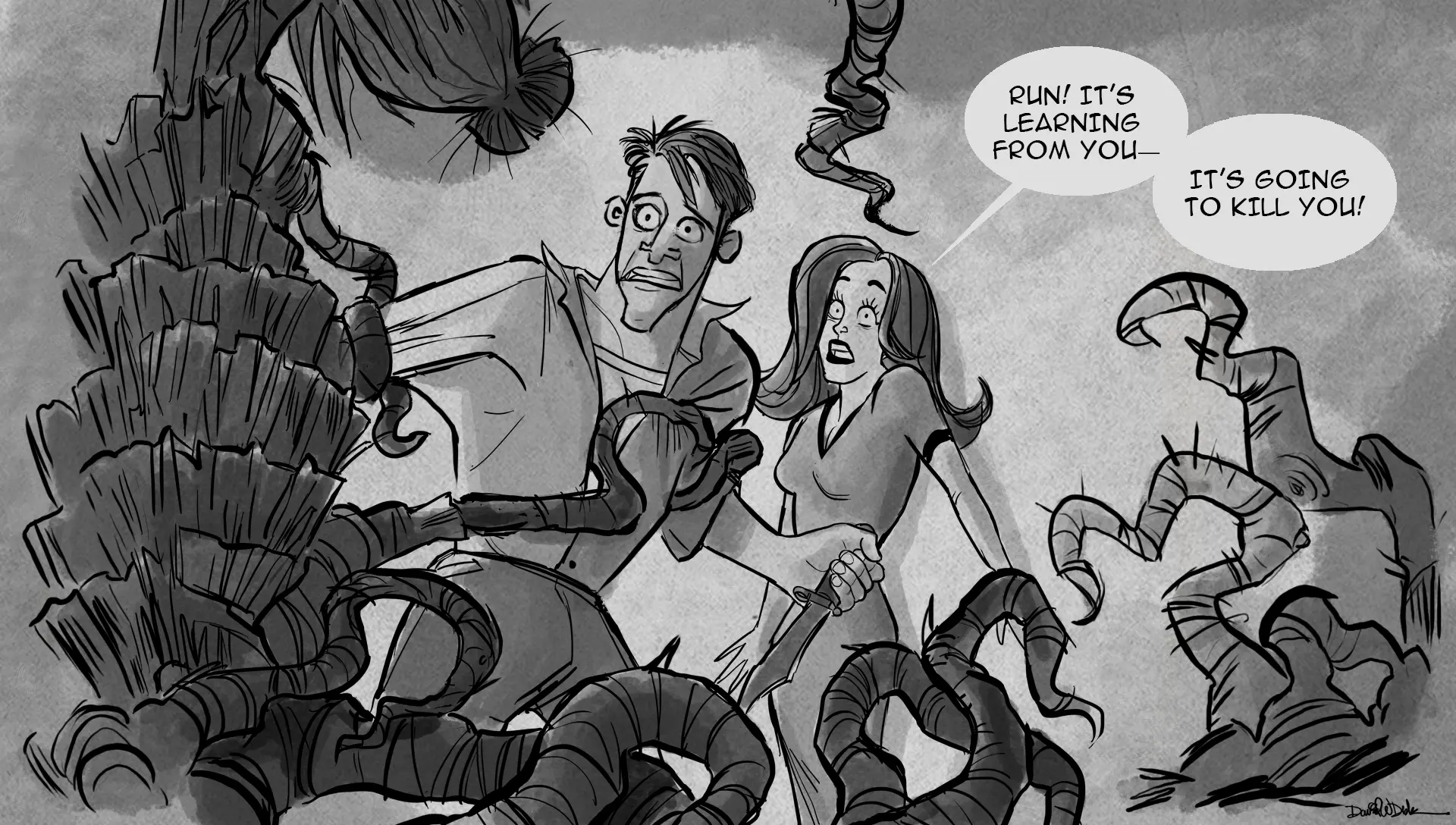
AI in animation was a topic that surfaced in nearly every panel I participated in this past weekend at Comic-Con—specifically, WonderCon 2026. The event itself was wonderful, full of energy, creativity, and community, but one conversation kept returning again and again: artificial intelligence.
It did not matter whether the discussion centered on storytelling, production, or the future of the industry. AI found its way into the conversation. And almost every time it did, the tone shifted. People leaned in. Some expressed excitement, while others grew noticeably uneasy.
That reaction is not surprising.
We are hearing a steady stream of messaging across news outlets and social media. AI is going to take jobs. It can create art faster than humans. It may replace roles across animation pipelines. During one panel, someone even suggested that certain studios are now requiring animation to be delivered with “50% AI.” That statement alone was enough to send a ripple of concern through the room.
As the conversations unfolded, however, a different realization began to take shape.
We are talking about AI constantly, but we are not clearly defining what it is.
“We are not just reacting to AI—we are reacting to how AI is being described to us.”
A Convention Floor as a Microcosm of a Larger Shift
What became increasingly clear is that WonderCon was not an isolated case. Instead, it served as a microcosm of a much broader shift unfolding across the entertainment industry—and, more broadly, across the workforce as a whole.
The uncertainty, curiosity, and concern expressed in those rooms are not unique to animation. They are being echoed across industries. People are trying to understand what AI actually does, which aspects of their work may be affected, and what remains uniquely human.
Underlying all of these questions is a deeper and more pressing concern: what should we actually believe about AI?
That question is becoming harder to answer, not easier.
The Problem: We Are Defining AI Through Noise
There is a fundamental gap in how AI is currently being discussed.
We are familiar with what AI appears to do. We have seen the demonstrations, the generated images, the voice recreations, and the headlines that frame the technology as both revolutionary and disruptive. However, much of what people believe about AI is shaped less by direct understanding and more by interpretation.
Information moves quickly, and as it moves, it evolves.
A comment made during a panel discussion becomes a takeaway. That takeaway is shared in conversation, then posted online, and eventually reframed as a broader statement. Over time, perception begins to carry the weight of fact.
“Perception is beginning to shape reality faster than understanding can catch up.”
This disconnect becomes even more important when we consider how rapidly AI itself is evolving. Recent research highlights that while AI is dramatically improving efficiency and expanding creative tools, it is still far from fully autonomous or universally reliable. One recent paper explores both the promise and the present limitations of AI systems.
Human Nature and the Echo Effect
It is important to recognize that this dynamic is not new. Human communication has always involved interpretation, simplification, and repetition.
However, in a moment where technology is evolving rapidly and emotions are heightened, those tendencies become amplified.
A statement such as “studios are using AI in their pipeline” can quickly evolve into “studios are replacing artists with AI.” While these statements are related, they are not equivalent. Yet in the flow of conversation—particularly in fast-moving environments like panels or social media—the distinction often disappears.
As nuance fades, what remains is a simplified version of the message, one that is easier to share but not necessarily more accurate.
This is how uncertainty grows. This idea becomes even clearer when you see it in action. Watch how a simple message changes as it moves from person to person in the example below.
View this post on Instagram
Fear Without Definition
When a concept is not clearly defined, it becomes easier to project fear onto it. AI, as it is currently discussed, often exists in this undefined space.
At the panels, I heard very real and very human concerns. Voice actors are questioning their future. Artists are wondering how their roles may evolve. Storyboard artists are considering whether their contributions could be reduced or replaced. Creators are asking whether storytelling itself might become automated.
These concerns are valid.
But they are also being discussed in a landscape where AI itself is still misunderstood. Even large-scale international research efforts, such as the growing body of AI safety literature, continue to emphasize that our understanding of AI’s risks and capabilities is still evolving.
“If we cannot define what AI is, we cannot accurately define what it will replace.”
AI in Animation: What It Actually Is
One of the most surprising aspects of these discussions around AI in animation is how rarely a basic question is asked: what is AI in the context of animation? Not in theory or in headlines, but in its practical, day-to-day application within a production pipeline.
To understand its impact, we need to move beyond generalizations and look at specifics. What tasks is AI currently performing? Where does it assist artists in meaningful ways, and where does it fall short? Just as importantly, where does human input remain essential—not as a preference, but as a necessity?
These are not abstract questions. They are practical ones, and emerging industry analysis is beginning to answer them. AI appears especially useful in repetitive or time-intensive production tasks, but it still struggles with consistency, control, and the nuances that creative professionals navigate every day. Recent reporting on AI animation tools points to both their efficiencies and their limitations.
Without addressing these realities directly, the conversation risks remaining speculative, shaped more by perception than by actual capability.
Creativity Still Sits at the Center
Another notable absence in these discussions is a deeper exploration of creativity itself.
There has been extensive focus on efficiency, production timelines, and cost reduction. While these are important considerations, they do not fully capture what animation represents as a creative medium.
Animation is not simply the act of producing images. It is the act of communicating meaning through movement, timing, and intention. It reflects perspective, experience, and choice.
This is where the conversation around AI in animation becomes especially important, because creativity—not efficiency—is what defines the medium.
This is where current research becomes particularly revealing. While AI can enhance production and help generate content, it still struggles to replicate emotional depth, narrative nuance, and originality—the very elements that give storytelling its resonance. Some recent scholarship has begun examining those creative limitations more directly.
Animation has always been about meaning and emotional resonance. That is true whether we are talking about film, television, or even live performance and community art. In our article Why Free Concerts Matter: Making Classical Music Accessible to All, we explored how human connection remains central to artistic experience. The same principle applies here.
“Can AI generate content, or can it create something that truly resonates?”
The Future of AI in Animation: Where This Goes Next
At this stage, the technology is advancing rapidly, and public reaction is advancing even faster. Understanding, however, is still in progress.
If WonderCon is any indication, we are currently in a phase where questions are outpacing answers. Perception shapes expectations, and concern fills the gaps where clarity has yet to be established.
This does not suggest that the concerns are misplaced. Rather, it highlights that the conversation itself is incomplete.
This conversation also connects to broader questions of storytelling, authorship, and creative ownership—subjects that continue to surface across DerksWorld as new technologies reshape how art is made and shared.
“Before we decide what AI means for animation, we need to agree on what AI actually is.”
This Is Not About Answers—Yet
This article is not intended to provide definitive conclusions.
Instead, it is meant to slow the conversation down and create space for more thoughtful discussion.
Before we determine what AI means for jobs, for creativity, or for the future of animation, we need to ensure that we are working from a shared understanding. At this moment, that understanding is still taking shape.
And that, more than anything else, may be the most important issue to address.
This conversation is far from over. As I move forward, I plan to continue exploring AI through research, discussion, and direct conversations with those who are actively building and shaping the technology. This will be a long conversation, and things will continue to change—perhaps more rapidly than we expect. Because understanding AI will not come from speculation alone, but will come from engaging with the people who know it best.